

December 3, 2025
By William P. Johnson, Professor, Department of Geology & Geophysics University of Utah
The US Magnesium Superfund Site is currently operational in a capacity dramatically below its previous full operation, and is not currently discharging waste to the so-called current waste pond (CWP). In October of this year, I provided a report titled: Analysis of the Phase 2B Hydro Data Report and Preceding and Subsequent Reports to summarize site conditions with respect to contaminant monitoring in groundwater. This analysis was requested by FOGSL and the Utah Division of Forestry, Fire, and State Lands (FFSL) due to the lack of implementation of the barrier wall for the retrofitted waste pond.
My analysis found that the layout of the wells to monitor contaminant transport downgradient from the CWP is sparse. For the downgradient diagonal edge of the CWP, only five wells were monitored, two in the upper aquifer zone (UAZ), and three in the lower aquifer zone (LAZ), with the two wells in the UAZ being most critical given that the hydraulic gradient was shown to be primarily upward.
The groundwater permit application from US Magnesium indicated that their waste pond area needed to increase by a factor of three in order to contain their waste, suggesting that approximately two-thirds of their waste discharge was previously unaccounted for and presumably discharged into groundwater below the CWP. That the retrofitted waste pond was designed to address a large unpermitted discharge from the CWP combined with the fact that only two UAZ wells existed along the nearly two-mile-long downgradient border of the CWP raised concern that the monitoring along this nearly two-mile-long boundary was inadequate to capture the extent of unpermitted discharge from the CWP.
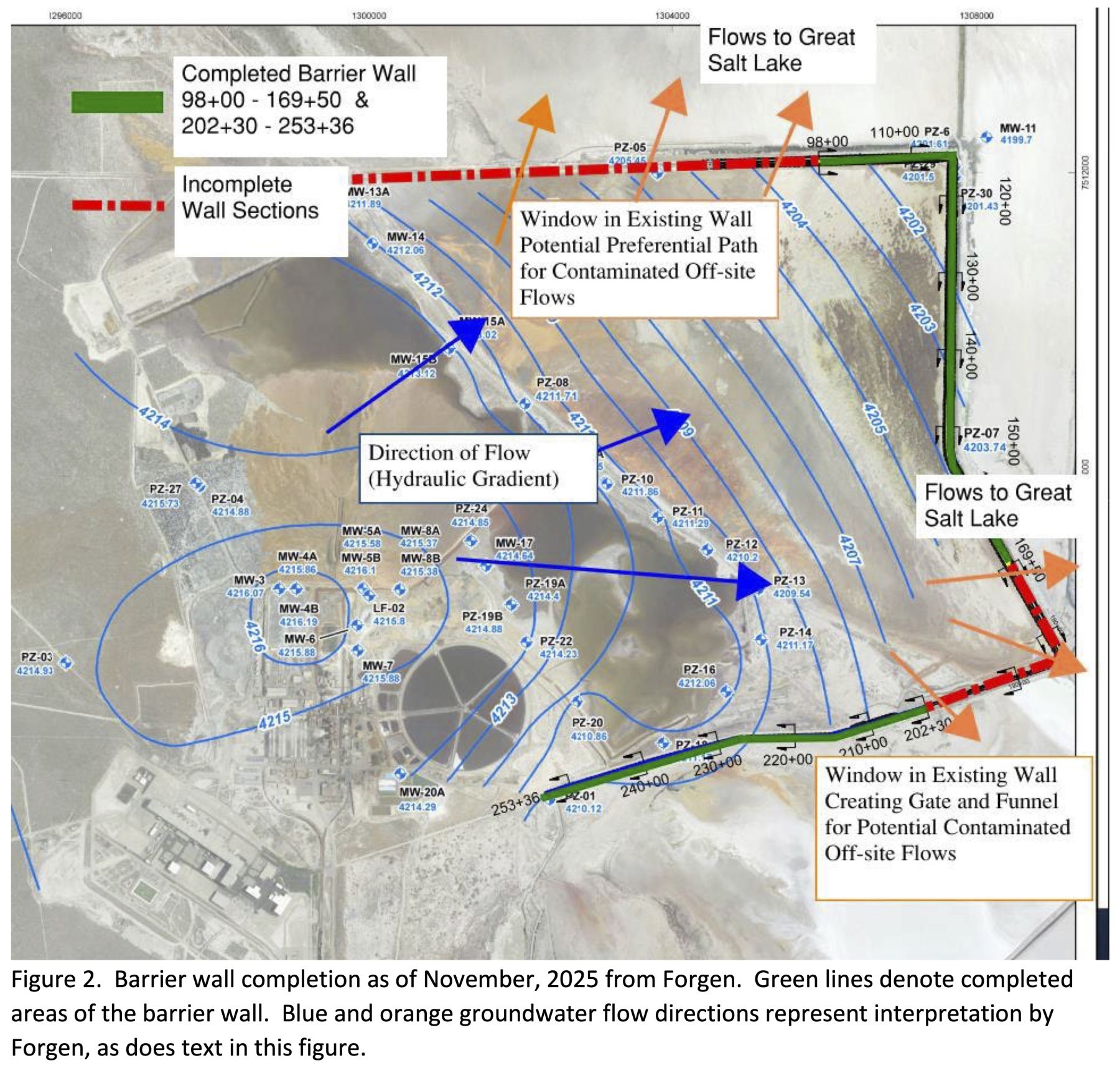
Information not previously available to me prior to my October analysis above became available to me in November, 2025. Specifically, the barrier wall contractor (Forgen) provided diagrams showing precisely where the barrier wall had been completed and notched into the underlying clay layer. This summary updates my analysis with this new information from Forgen. It also expands the analysis via consideration of relative concentrations detected for waste water tracers. This analysis is intended to further guide monitoring efforts to constrain the extent of contamination to groundwater.
