
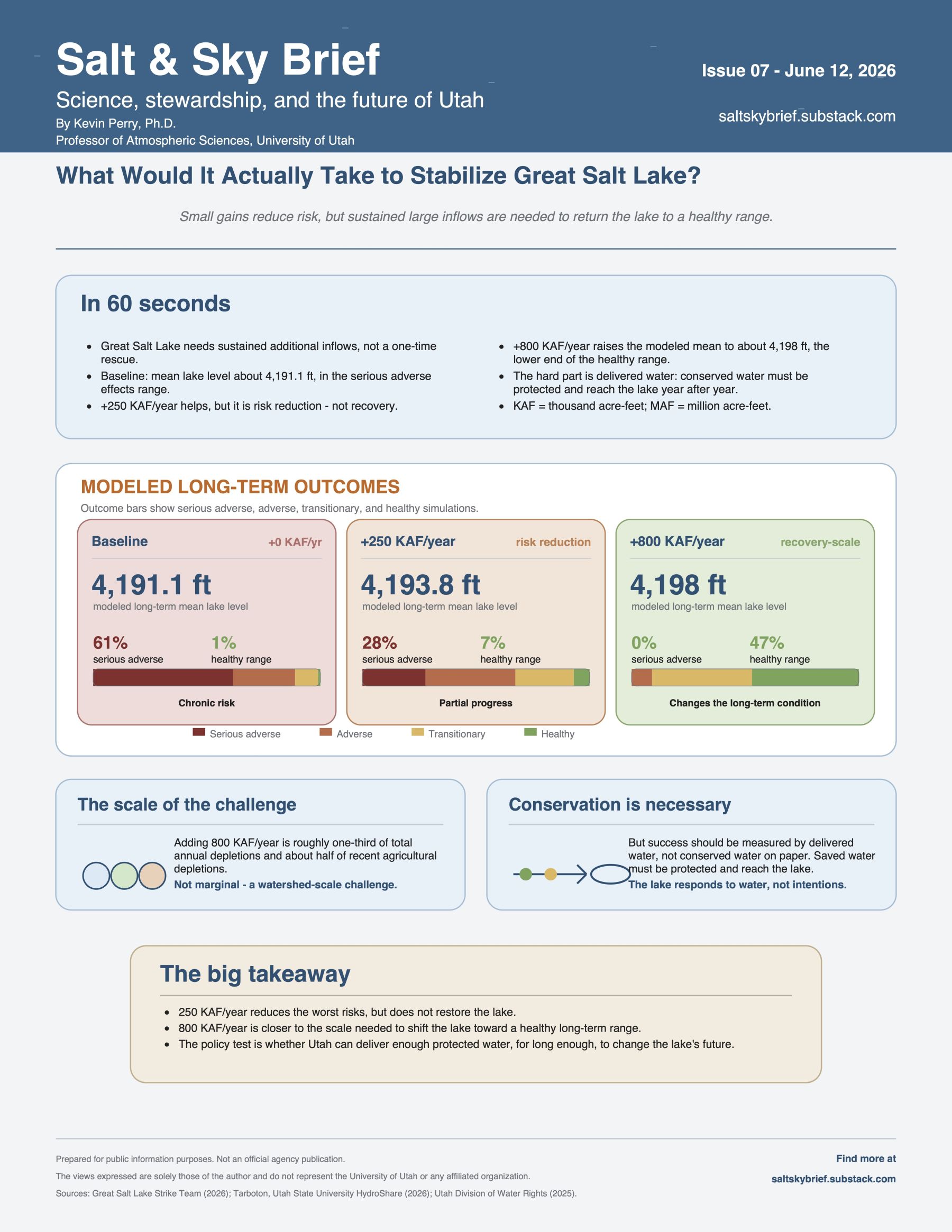
What Would It Actually Take to Stabilize Great Salt Lake?
New modeling suggests small gains reduce risk, but sustained large inflows are needed to return the lake to a healthy range.
Welcome to Salt & Sky Brief — a bi-weekly note on Utah science and the public decisions it informs.
This issue continues the Great Salt Lake series by asking a deceptively simple question: how much additional water would it actually take to stabilize the lake?
The answer is not “one wet winter.” Great Salt Lake will always rise and fall with snowpack, precipitation, runoff, temperature, and evaporation. The more useful question is whether Utah can shift the lake’s long-term range upward, so that dry years start from a safer place and wet years help rebuild the system rather than merely slow its decline. In this issue, stabilization does not mean holding the lake at one elevation; it means raising the lake’s long-term range enough to avoid chronic serious adverse effects.
Recent modeling from the Great Salt Lake Strike Team puts numbers on that question by comparing a baseline future with scenarios in which additional water reaches the lake year after year. The results are clear: 250,000 acre-feet per year would reduce risk, but roughly 800,000 acre-feet per year is the scale that begins to move the lake back toward a healthy long-term range.
In 60 seconds
-
Great Salt Lake does not need a one-time rescue. It needs sustained additional inflows over many years.
-
In the baseline scenario, average riverine inflow to the lake is about 1.665 million acre-feet per year. The modeled long-term mean lake level is about 4,191.1 feet, within the “serious adverse effects” range.
-
Adding 250,000 acre-feet per year improves the outcome. It raises the modeled long-term mean lake level to about 4,193.7–4,193.8 feet and reduces the probability of serious adverse effects from 61% to 28%.
-
But 250,000 acre-feet per year is a risk-reduction scenario, not a recovery scenario. The lake still spends most of its modeled future below the healthy range.
-
Adding 800,000 acre-feet per year changes the picture. The modeled long-term mean lake level rises to about 4,198 feet, within the healthy lake elevation range.
-
The hard part is not knowing whether more water would help. The hard part is delivering enough protected water to the lake, year after year, to change the lake’s long-term trajectory.
Read the full issue on SubStack.
About Salt & Sky Brief
Salt & Sky Brief is a bi-weekly, one-page newsletter focused on Utah’s air quality, water systems, the Great Salt Lake, energy affordability, and public education.
Each issue breaks down complex environmental and policy questions into clear, evidence-based analysis — explaining not just what is happening, but why it matters for Utah’s long-term health, economy, and communities.
The newsletter is written by Dr. Kevin Perry, Professor of Atmospheric Sciences at the University of Utah. An expert in air quality, his research has examined dust emissions from exposed lakebeds across the Intermountain West and the environmental impacts of the Great Salt Lake. He is a member of the Great Salt Lake Strike Team and has been recognized as a University of Utah Presidential Societal Impact Scholar for his public education and outreach.
Salt & Sky Brief is grounded in science, guided by data, and committed to practical, durable solutions.