
Why Great Salt Lake Is Out of Balance
The lake has always fluctuated. Today, too little water reaches it.
Welcome to Salt & Sky Brief — a bi-weekly note on Utah science and the public decisions it informs.
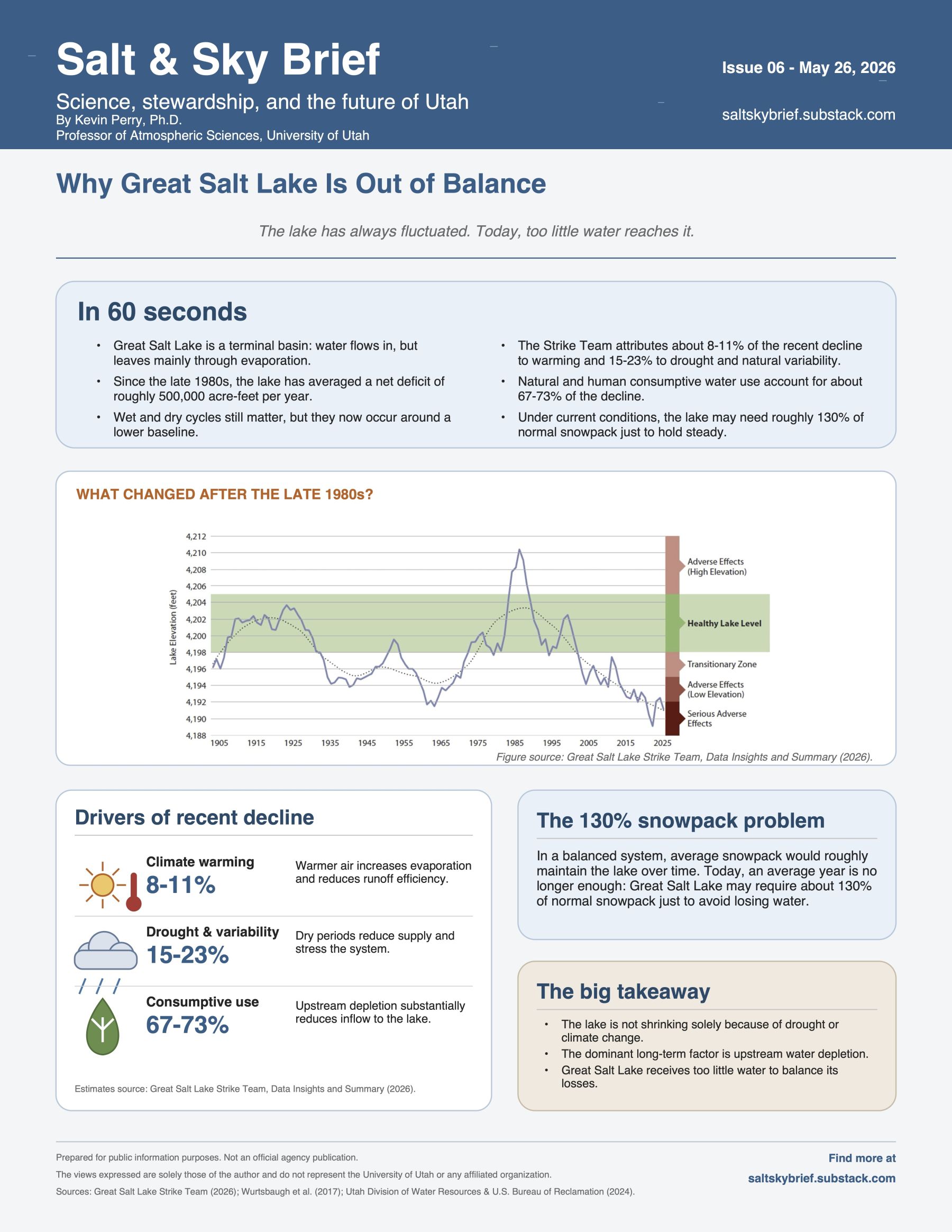
This issue focuses on Great Salt Lake as a water-balance problem. The lake has always risen and fallen with wet and dry periods, but its recent decline differs from past fluctuations. Since the record-high levels of the late 1980s, the lake’s long-term trend has been downward because inflows reaching the lake have generally been too low to balance evaporation.
In 60 seconds
- Great Salt Lake is a terminal basin lake: water flows in through rivers, groundwater, and precipitation, but it has no outlet to the ocean. Water leaves mainly through evaporation.
- Since the late 1980s, Great Salt Lake’s long-term water balance has averaged a net deficit of roughly 500,000 acre-feet per year, reflecting a persistent imbalance between inflow and evaporation.
- The Great Salt Lake Strike Team estimates that climate warming accounts for about 8–11% of the recent decline, drought and natural variability account for about 15–23%, and natural and human consumptive water use account for about 67–73%.
- Water depletion has shifted the lake’s baseline downward. Under current conditions, Great Salt Lake requires roughly 130% of normal snowpack just to maintain its level in a given year.
- The takeaway: Great Salt Lake is not shrinking solely because of drought or climate change. Long-term upstream water consumption has substantially reduced the inflows reaching the lake.
READ THE FULL ISSUE ON SUBSTACK.
About Salt & Sky Brief
Salt & Sky Brief is a bi-weekly, one-page newsletter focused on Utah’s air quality, water systems, the Great Salt Lake, energy affordability, and public education.
Each issue breaks down complex environmental and policy questions into clear, evidence-based analysis — explaining not just what is happening, but why it matters for Utah’s long-term health, economy, and communities.
The newsletter is written by Dr. Kevin Perry, Professor of Atmospheric Sciences at the University of Utah. An expert in air quality, his research has examined dust emissions from exposed lakebeds across the Intermountain West and the environmental impacts of the Great Salt Lake. He is a member of the Great Salt Lake Strike Team and has been recognized as a University of Utah Presidential Societal Impact Scholar for his public education and outreach.
Salt & Sky Brief is grounded in science, guided by data, and committed to practical, durable solutions.