
Utah Geological Survey
Department of Natural Resources
Bio:
Paul Inkenbrandt has been a Senior Scientist and hydrogeologist with the Utah Geological Survey since September 2009. He has a M.S. in geology from Utah State University and a B.S. from the University of Southern Indiana. Paul runs the Utah Flux Network, a network of eddy covariance stations that measure evapotranspiration. Paul is experienced in database management, geographic information systems, and Python scripting. He also teaches introductory geology at Salt Lake Community College. In his personal time, he is actively involved in the Utah Geological Association, maintains his vegetable garden, and spends time with his family.
Title: Getting to know the invisible sweaty giant of GSL
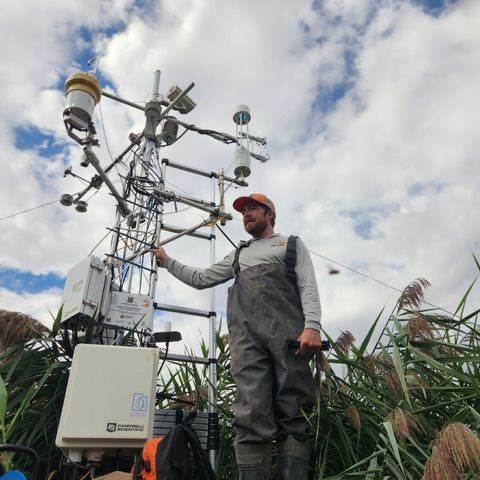
Abstract: The Utah Geological Survey, in collaboration with the Utah Division of Water Resources and the Utah Division of Forestry, Fire, and State Lands, (and many others) has set up a weather station in an invasive Phragmites australis patch in Farmington Bay. This station is measuring evapotranspiration (ET) before and after treatment of the Phagmites to learn more about how this plant and its treatment affects Great Salt Lake hydrology and ecosystems. We are also using this station to validate satellite estimates of ET from OpenET. The OpenET data can tell us how much water has been intercepted by Phragmites since it encroached after the lake receded. The OpenET data also informs us how effective management efforts are. We hope to expand ET around the lake to better quantify water budgets in different systems, including open water and impoundments. This presentation will discuss the technology used to measure and estimate ET and its limitations, where more measurement is needed, and why ET measurement matters.