
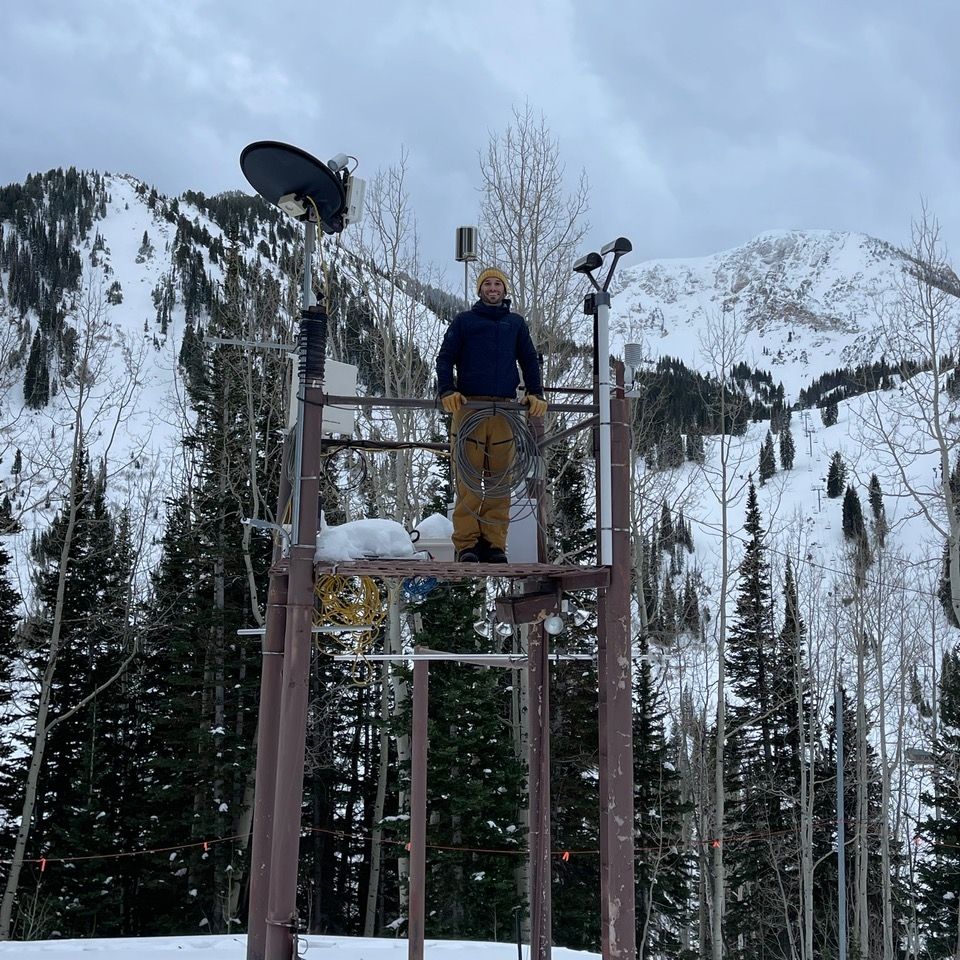
Associate Research Professor
University of Utah
Bio:
Peter Veals is an Associate Research Professor at the University of Utah. His research has included thunderstorms in the tropics, improving weather radar on commercial airliners, lake-effect snow in the Great Lakes, sea-effect snow in Japan, orographic snowfall in the Wasatch, cloud seeding, and snowmaking. He can often be found coding up new forecasting tools on weather.utah.edu, fixing cranky instruments in the middle of a blizzard, or out exploring the many landscapes of Utah.
Title: More water, please! A look at the efficacy and physics of seeding winter storms over mountainous regions, and an overview of the SNOWSCAPE campaign going on this winter in Utah
Abstract: Glaciogenic cloud seeding, most commonly using silver iodide, is conducted in an attempt to increase the amount of liquid precipitation equivalent (LPE) falling from clouds. Seeding has been conducted in the Mountain West for decades, but its efficacy has been the subject of much debate. Until recently, very few of the studies that had attempted to quantify the efficacy of glaciogenic seeding were statistically and scientifically rigorous. That has changed in the past two decades, with major campaigns and highly cited papers in trustworthy journals dedicated to the task. This work suggests that, at least in interior mountain ranges of the Western US, ground-based seeding likely has a minuscule or nonexistent effect. When seeding is conducted inside clouds using aircraft, however, the picture is different. Seeding has a clear positive effect, with substantial increases in the LPE rate that trace the exact locations where the silver iodide is being dispersed. This result, observed in 2017, has led to a huge increase in demand for glaciogenic seeding in much of the Western US, including Utah. The state is now allocating millions of dollars per year to its cloud seeding program, including for a major field campaign to study its efficacy: SNOWSCAPE. SNOWSCAPE is taking place from Jan–Mar 2026 in the northern Wasatch, and involves over 20 scientists from the University of Utah and Utah State. The final portion of the talk will describe the array of instruments that are deployed for the campaign, and some of the research goals.