
Bio:
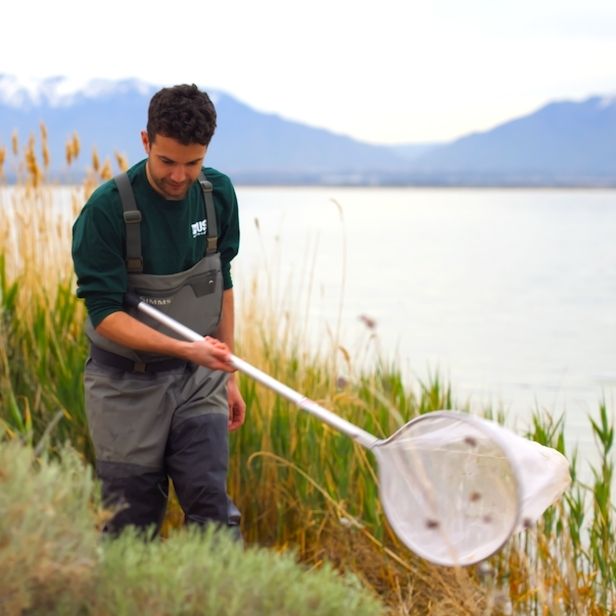
Dr. Samuel (Sam) Lopez is a Principal Investigator with the U.S. Geological Survey Utah Water Science Center. He holds a Ph.D. in Geology from the University of Utah and a B.A. in Chemistry from Grinnell College. Sam’s research explores contaminant sources and cycling at Great Salt Lake and across the Great and Colorado River Basins. His research interests include the application of metal stable isotopes in contaminant studies, contaminant bioaccumulation in invertebrates and waterbirds, and the impacts of wildfire on water quality. In 2022, Sam received the Doyle W. Stephens Scholarship from FRIENDS of Great Salt Lake. When not at his desk or wading through mud to collect samples, he enjoys discovering new rivers to fly fish and experimenting with cooking.
Title: Why is Selenium in South Shore Bird Eggs on the Rise?
Abstract: The Great Salt Lake (GSL) system contains elevated concentrations of trace metals, posing a potential risk to millions of birds that utilize the lake on an annual basis. Recent studies of GSL sediment cores have provided insight into changes in trace metal inputs and source contributions to the lake over time. Concentrations of metals such as mercury and lead in sediments deposited after 1920 are up to 40 times higher than pre-1920 levels, peaking between 1965 and 1995. Metal stable isotopes during this time indicate a shift in source contributions from natural background to mining-linked sources. Declines from peak concentrations and slight rebounds in metal stable isotope signatures towards pre-1920 values follow closure of several local smelters and the onset of increased emission controls and implementation of cleaner technologies, demonstrating that 1) the GSL system responds relatively quickly to changes in metal inputs, and 2) regulations such as the Clean Air Act are effective at limiting pollution to water bodies such as GSL. While many metals, such as mercury, lead, copper, zinc, and antimony, exhibit declines following peak concentrations, sediment cores show increasing selenium (Se) concentrations, suggesting long term Se deposition to GSL sediments may be increasing. Metal stable isotopes suggest the onset of increased Se contamination is related to local metal production, but current Se sources driving potentially increased deposition and elevated concentrations in bird eggs are under characterized, pointing to a need for continued investigation of Se sources, distribution, and bioaccumulation at GSL. This presentation will provide an overview of recent Se and trace metal studies at GSL and discuss ongoing projects and coordination between the USGS Utah Water Science Center and academic, state, federal, non-profit, and industry collaborators to better understand Se at GSL.