
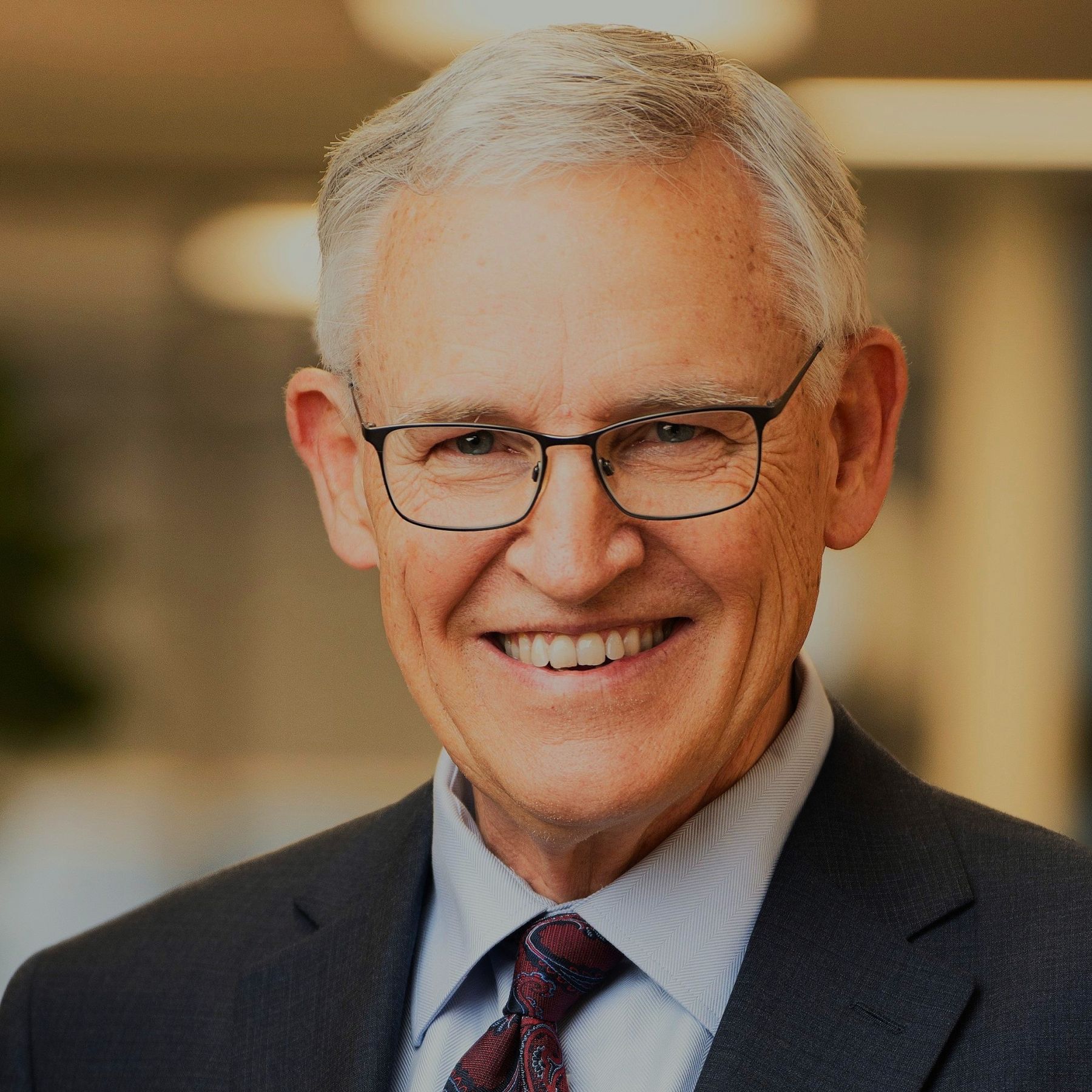
Agricultural Liaison
Great Salt Lake Advisory Council
Bio:
My path, or bio, of learning about the Lake follows, though reading it is optional and only faintly recommended:
In about 1958, my father, always a practicing naturalist, took my older brother and me to Saltair. We floated, showered, marveled, and then listened to him explain the Lake’s geological history as he drove home. Thus began my lifelong fascination with Great Salt Lake.
Studies at Utah State University included public policy and regional economics, with emphasis on aligning natural resources policy with economics, market forces, and individual incentives.
In 1977, while still a student at the University of Utah College of Law and as a law clerk at Kirton McConkie, my first professional experience with Great Salt Lake Basin water came though an application to appropriate. Upon admission to the bar in 1978, I practiced at Kirton McConkie in agricultural and water law, including Utah Lake and Jordon River interests.
In 1981, Thorpe Waddingham invited me to an office sharing arrangement in Delta, Utah - the hometown to which I had intended to never return, to be the Delta City attorney. Intermountain Power Project was transitioning from drawing board to earthwork. This tested my research on energy development boom towns vs. construction of the largest coal-fired power plant in the United States. It was a crash course in short and long range regional planning.
Early in our work together, Thorpe gave me a hand-drawn, 70-year hydrograph of Great Salt Lake, along with a lecture on the Lake’s behavior patterns and an admonition to learn more. Thorpe was the only Utah state senator to: a) successively serve as majority leader, senate president, and minority leader, and b) to be presented with a live Gunnison Island white pelican - on the Senate floor during open session - for his work on behalf of the species and its habitat. He gave an intensive study in practical politics, mixed with heavy doses of water law and policy. During the 1983 to 1987 flooding around the Great Salt Lake, Gov. Norman H. Bangerter and his chief of staff called often called Thorpe for counsel on managing the West Desert Pumping Project. In turn, I became Thorpe’s sounding board.
Beginning in 1987, I endured four years of forced labor followed as the elected Millard County attorney. When I returned to private practice, I was engaged for several years’ in another regional economic development project. It was privately capitalized and based in agriculture.
Hands-on experience with Great Salt Lake came in March 1995 through 2007 as I served for 12 years on the Utah Board of Water Resources. My Great Salt Lake horizons expanded in 2004 when I met Dr. Bonnie Baxter, now widely recognized as a maven of the Lake. She guided my daughter on a day-long tour of Westminster College (now Westminster University). Great Salt Lake may have been mentioned a time or two. Her recruitment efforts were fruitful.
In 2007, I was recruited to be land and natural resources vice-president of an international food production company. This provided broad experience in comparative land and water management across 30+ domestic and international jurisdictions, and engagement in planning and policy regarding the air, transportation, and water needs of Utah Valley.
In 2020, I retired. I presently serve on the Utah Water Task Force and Legislative Water Development Council, Utah Watersheds Council and as agricultural liaison to the Great Salt Lake Advisory Council. Since May 2000, I have consulted as a water policy advisor for Utah Farm Bureau Federation and its members. My better part says that I am not good at retirement.
Title: Water Rights for Great Salt Lake – Are We Any Closer to Achieving That Dream?
Abstract: Every Forum participant has their own path to Great Salt Lake involvement. Many of us have quietly worked for years to improve prospects for the Lake. Today, a crescendo in awareness and knowledge about the Lake sounds across many quarters and motivates us to do more. Can anyone who claims to be fascinated by Great Salt Lake not be engaged in learning about the Lake and then acting on its behalf? Here is my list of key lessons learned, so far.
My Great Salt Lake involvement has taught these key lessons:
- First define the problem, then design the solutions.
- Decisions must be based on fact and sound science rather than mere opinion. “Too often we enjoy the comfort of opinion without the discomfort of thought.”[1] Soundbites seldom contain serious solutions.
- In a world of finite resources and limited time, our actions must be fact based and focused.[2]
- Look forward. Focus on solutions. Look back only for lessons learned and to collect knowledge and wisdom. Fixing blame does not create water.
- We are in this together. No one cares more about meeting the needs of Great Salt Lake than those who live here. To others we say, “Bring answers and resources if you have them, just don’t distract us or delay our efforts.”
- No single discipline, person, or group can accomplish the tasks ahead. Unprecedented communication and cooperation at a heretofore unseen scale are needed.
- We face difficult tradeoffs. “[T]radeoffs . . . must be weighed holistically”[3] At the same time, false tradeoffs that yield nothing help no one. For example, if we shut down all farming in the Basin and that does not restore the Lake, how can we replace what we will have lost?
- Those who live in the Great Salt Lake Basin cannot become casual about growing food. After four years of negative ag balance of trade, can we afford to ignore food security?
- Education is vital. The Lake has taught us much - and still has much to teach us.
The Utah Legislature has provided tools to thoughtfully reconfigure society’s use of water in the Great Salt Lake Basin, though better staff funding for certain agencies would help. If any people can cooperate save an endorheic lake from desiccation, it has to be the people of Utah. Can we do it? Gina Raimondo, in a recent New York Times opinion piece on AI, gave an apt call to action that can also be applied to our situation with Great Salt Lake:
A new grand bargain between the public and private sectors can help us meet this moment. I know we have the ingenuity to do it. What’s missing now is the collective will.[4]
[1] John F. Kennedy, Yale Commencement Address, June 11, 1962.
[2] For instance, farming and farmers, acting alone, did not bring us to the current circumstances. Great Salt Lake Basin farmers in the Utah portion of the basin use less water today than in 1983-1985.
[3] Great Salt Lake Data and Insights Summary, A synthesized resource document for the 2026 General Legislative Session, p. 7.
[4] Raimondo, Gina. “America Cannot Withstand the Economic Shock That’s Coming.” New York Times, March 6, 2026. https://www.nytimes.com/2026/03/06/opinion/ai-labor-unemployment.html.