
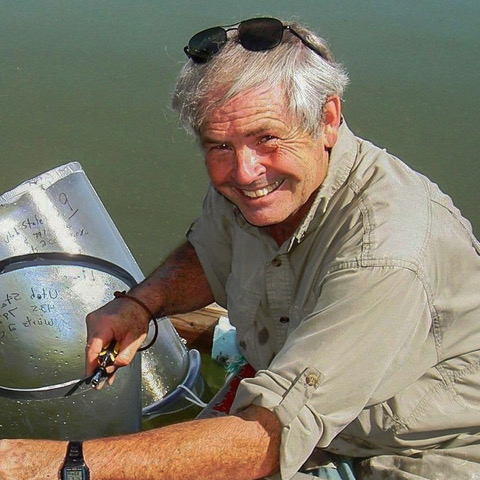
Professor Emeritus, Dept. of Watershed Sciences and the Ecology Center
Utah State University
Bio:
I earned B.S. and M.S. degrees in Fisheries and Water Pollution from U.C. Davis and Oregon State Univ., and a Ph.D. in Ecology at Davis. I have taught and done research at Utah State University since 1983, working on the fisheries and limnology of Bear Lake and Utah’s reservoirs, and on the lakes and streams in the Sawtooth Mountains of Idaho. I began working on Great Salt Lake in 1985, and have studied the brine shrimp, birds, metal contamination, and recently, the factors causing the desiccation of the lake. Recent publications include a paleolimnological study of the history of metal contamination, a remote sensing project on the distribution and seasonality of phytoplankton, and a study of toxic algal blooms in Farmington Bay. As a member of the Division of Forestry, Fire and State Lands Technical Team, I am involved in reviewing a variety of projects on the ecology and hydrology of the lake, and in conveying this information to the public. Other saline lake projects I have been involved in are the limnology of Argentina’s Mar Chiquita and Peru’s Lake Titicaca, and the desiccation of Iran’s Lake Urmia, which was once nearly identical to our lake, but now has shrunk to <5% of its original size. Understanding their mistakes will hopefully keep us from a similar fate here. In addition, I frequently collaborate with personnel from the Utah Divisions of Water Resources, Water Quality, Wildlife Resources, the U.S. Geological Survey, the Great Salt Lake Brine Shrimp Cooperative, and conservation groups such as FRIENDS of Great Salt Lake, Grow the Flow, and Audubon.
Title: Death in Iran: Lake Urmia, Somayeh Sima and the Struggle for Humanitarian and Ecological Justice
Abstract: Like many saline lakes worldwide, Iran’s Lake Urmia has been severely desiccated due to water development in its watershed. This “sister lake” was once nearly identical to our own Great Salt Lake (Wurtsbaugh and Sima 2022), but high population growth forced intensive water development for agriculture in the Urmia basin 25 years ago, severely disrupting the water supply to the lake. Research by my Iranian colleague, Dr. Somayeh Sima (Tehran), and many others, documented what was needed to save Lake Urmia. The Iranian government originally pledged $5 billion for the recovery, but far less was actually spent as priorities shifted elsewhere, and the lake has died. “Lake Urmia has now completely dried up, and, except for temporary inundations after rains and snow, minimal wastewater effluents are the only inflows….In a nutshell, the environment hasn't been a priority for our illegitimate regime so far and won't be from now on.”—Somayeh Sima, February 2026. Dust storms are now common in the area, and the brine shrimp that supported thousands of flamingos and other birds are gone. Not only has Lake Urmia died, but political injustice has been taken its toll on Somayeh and thousands of others. Somayeh lost her university position because she supported students protesting the killing of a woman by “morality” police. The current U.S. administration then denied her a visa to come to the U.S. to work at BYU and study Great Salt Lake. Finally, she witnessed the brutal crackdown of the Iranian government on thousands of demonstrators demanding change in Iran, and most recently, the bombing of her homeland by the U.S. and Israel. These sad stories emphasize that to save Great Salt Lake and promote ecological and humanitarian justice worldwide, we must reconsider what our political and social priorities will be in the coming years.